
This article contains affiliate links. If you sign up through my links, I earn a commission at no extra cost to you. This never affects my reviews — I cover the good and the bad.
Metricool vs Hootsuite vs Buffer 2026: Which Social Media Management Tool Is Actually Worth Your Money?
If you are trying to pick a social media management tool in 2026, you have probably narrowed it down to these three. They are the names that come up in every recommendation thread, every "best tools" list, and every freelancer community. But they are very different tools at very different price points, and most comparison articles just list features in a table without telling you what it actually feels like to use them.
I have tested all three. Here is what I found.
The Quick Verdict (If You Are In A Rush)
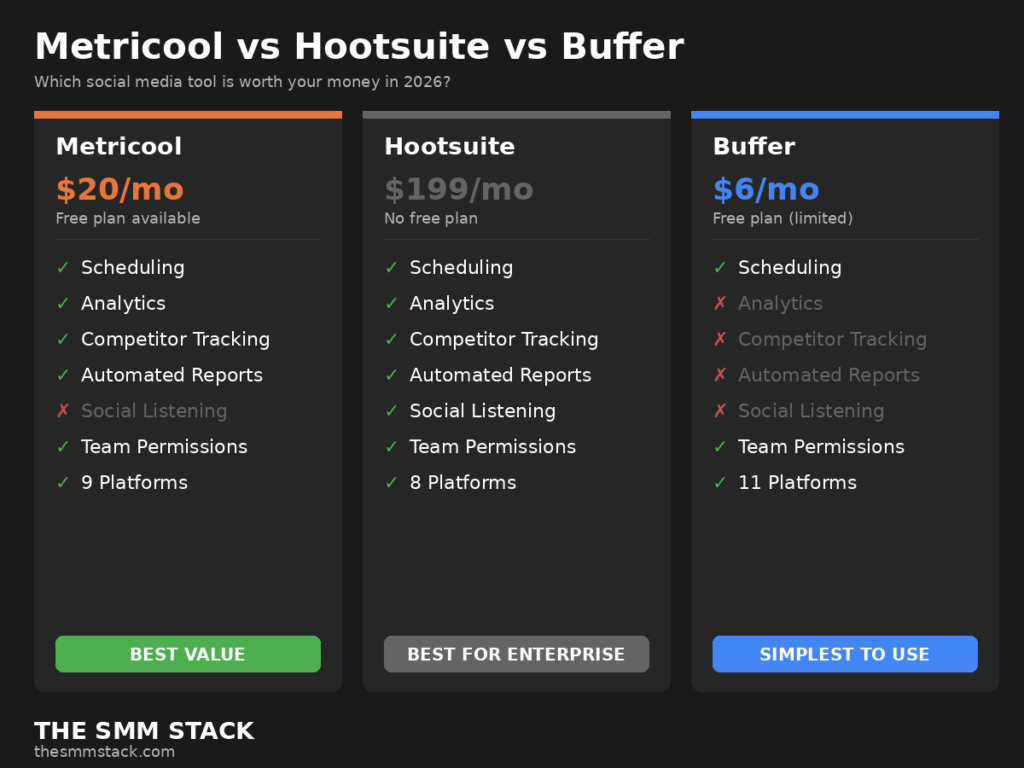
If you are a freelancer or small business and budget matters: Metricool. It gives you scheduling, analytics, and competitor tracking for $20 a month. The free plan alone is enough for most solo users. This is the one I use personally.
If you want the simplest possible scheduling tool and nothing else: Buffer. Clean interface, easy to learn, gets the job done without overwhelming you. Starts at $6 a month per channel.
If you are an agency or enterprise team that needs advanced features: Hootsuite. It has social listening, complex team permissions, and ad management. But it starts at $199 a month and you will feel every dollar of that.
Pricing Comparison
Let me just put the numbers next to each other because this is where the conversation starts and ends for a lot of people.
Metricool: Free plan available. Starter plan $20/month (5 brands, unlimited posts). Advanced plan $53/month (15 brands).
Buffer: Free plan available (3 channels, 10 posts per channel). Essentials plan $6/month per channel. Team plan $12/month per channel.
Hootsuite: No free plan. Standard plan $199/month per user (5 social accounts). Advanced plan $399/month per user (unlimited social accounts). Enterprise is custom pricing.
Read those Hootsuite numbers again. For the price of one month of Hootsuite Standard, you could run Metricool's Starter plan for almost ten months. Ten. Months. Or you could buy Buffer for every social platform you own and still have enough left over for a nice dinner every week.
The pricing gap here is not subtle. If you are a freelancer paying $199 a month for Hootsuite, I genuinely want to know what it is doing for you that Metricool at $20 cannot. Because in my testing, the answer for most people is "not much."
And it gets worse for Hootsuite if you have a team. Their pricing is per user, which means adding a second person doubles your bill to $398 a month. A three-person team on Standard is paying $597 a month. For social media scheduling. Meanwhile Metricool's Advanced plan at $53 a month includes team collaboration features. The maths speaks for itself.
Scheduling and Content Planning
All three tools let you schedule posts across multiple platforms. That is table stakes in 2026. The differences are in how they do it and what else they give you alongside it.
Metricool
Metricool uses a visual calendar that shows everything scheduled across all platforms in one view. You can drag and drop to reschedule, preview posts for each platform, and use the "Optimal Time" feature that suggests when to post based on your audience data. It supports Facebook, Instagram, X, LinkedIn, TikTok, Pinterest, YouTube, Threads, and Google Business Profile — nine platforms total.
One feature I like is the first comment scheduling for Instagram. If you use hashtags in comments rather than captions, Metricool handles it automatically. Small thing, saves real time.
The free plan gives you 50 scheduled posts per month. The paid plans give you unlimited.
Buffer
Buffer's scheduling interface is the cleanest of the three. It is almost aggressively simple — you write your post, pick your platforms, pick a time or let Buffer choose, and you are done. If you have ever felt overwhelmed by a SaaS dashboard, Buffer is the antidote.
Buffer supports Facebook, Instagram, X, LinkedIn, TikTok, Pinterest, YouTube, Threads, Google Business Profile, Mastodon, and Bluesky. That is actually more platforms than Metricool, which is worth noting if you are active on newer platforms.
The catch is that Buffer's free plan only gives you 3 channels with 10 scheduled posts each. That runs out fast if you are posting daily. And on the paid plans, you pay per channel — so if you manage 5 platforms, that is $30 a month on the Essentials plan. Managing 10 channels pushes you to $60 a month, at which point the simplicity advantage starts looking less compelling compared to Metricool's $20 flat rate.
Hootsuite
Hootsuite's scheduling is solid but the interface feels heavier than both Metricool and Buffer. There are more menus, more options, and more things competing for your attention. For a single user managing a few accounts, it is overkill. For a team managing dozens of accounts with approval workflows, it makes more sense.
Hootsuite supports a similar range of platforms and has a bulk scheduling feature that lets you upload a CSV of posts — useful if you are planning a month of content in one sitting. But you are paying $199 a month minimum for any of this, and the Standard plan only gives you 5 social accounts. If you need more, you are looking at the $399 a month Advanced plan.
Winner: Scheduling
For most people, Metricool. You get unlimited scheduling on paid plans for $20 a month across 9 platforms with a visual calendar and optimal time suggestions. Buffer wins on simplicity but the per-channel pricing gets expensive once you manage more than a handful of accounts. Hootsuite wins on team features but the $199 starting price is genuinely difficult to justify unless you are an established agency billing clients enough to absorb that cost.
Analytics
This is where the three tools diverge the most.
Metricool
Analytics is arguably Metricool's strongest feature. For every connected platform, you get detailed breakdowns — engagement rates, reach, impressions, follower growth trends, best performing posts, and a heatmap showing when your audience is most active. The data is presented visually and is easy to interpret without a statistics degree.
The automated reporting is a standout. Metricool generates monthly reports in PDF and PowerPoint that you can brand with your logo on paid plans. If you send reports to clients, this alone saves hours every month compared to doing it manually. I used to screenshot each platform individually and paste them into a Google Doc like some kind of digital scrapbook. Metricool handles it in about two clicks.
Buffer
Buffer's analytics are basic. You get engagement stats per post — likes, comments, shares, clicks — and some overall account metrics. It does the job if you just want to see which posts performed well. But there is no competitor tracking, no audience heatmaps, no automated reporting, and the depth of data does not come close to what Metricool offers at a lower price point.
Buffer recently added an AI assistant for content suggestions, which is nice but does not compensate for the analytics gap.
Hootsuite
Hootsuite's analytics are strong, comparable to Metricool in depth, with the addition of social listening — monitoring brand mentions and keywords across the internet. If tracking what people say about your brand outside of your own posts matters to you, this is where Hootsuite genuinely pulls ahead of the other two.
Hootsuite also has customisable dashboards where you can build your own analytics views. Powerful, but again — $199 a month minimum, and advanced analytics features are locked behind the $399 Advanced plan.
Winner: Analytics
Metricool for the vast majority of users. You get deep analytics, automated reports, and competitor tracking at a fraction of Hootsuite's price. The only reason to choose Hootsuite here is if you specifically need social listening capabilities. Buffer is not in this race — its analytics are too basic for anyone who cares about data-driven decisions.
Competitor Tracking
Metricool
This is a feature that Metricool has and Buffer simply does not. You can add competitor profiles and track their posting frequency, engagement rates, follower growth, and most popular content. The free plan lets you track 5 competitors. Paid plans let you track up to 100.
For freelancers managing client accounts, being able to drop a competitor analysis into your monthly report is a genuine value-add. Clients love seeing how they stack up against competitors and it takes you about 30 seconds to pull the data.
Buffer
No competitor tracking. At all. If you want this, you need a separate tool.
Hootsuite offers competitor tracking and broader social listening. The competitor features are solid but they come bundled with the $199 a month price tag at minimum. You cannot access them on a cheaper plan because there is no cheaper plan.
Winner: Competitor Tracking
Metricool and it is not close. Free competitor tracking for 5 profiles on the free plan, 100 on paid plans starting at $20 a month. Hootsuite charges $199 minimum for similar features. Buffer does not offer it at any price.
Ease of Use
Metricool
Metricool has a moderate learning curve. The dashboard is feature-rich which means it takes about an hour to get comfortable navigating everything. Once you know where things are, it flows well. But the first session can feel like walking into a cockpit when you were expecting a bicycle.
Buffer
Buffer wins ease of use by a mile. You can sign up and schedule your first post within about three minutes. The interface is minimal, intuitive, and never makes you think. If "simple" is your top priority above everything else, Buffer is the answer. It does one thing and does it beautifully.
Hootsuite
Hootsuite's learning curve is the steepest of the three. More features means more complexity. The dashboard has evolved over years of adding capabilities and it shows — things are not always where you would expect them. There are tutorials and onboarding flows to help, but expect to spend a few hours before you feel productive.
Winner: Ease of Use
Buffer. Clearly. If you just want to schedule posts without thinking about it, Buffer does it better than anyone. Just be aware that simplicity comes at the cost of depth.
Platform Support
All three cover the major platforms. Here is the breakdown:
Metricool: Facebook, Instagram, X, LinkedIn, TikTok, Pinterest, YouTube, Threads, Google Business Profile. Nine platforms. LinkedIn requires a paid plan.
Buffer: Facebook, Instagram, X, LinkedIn, TikTok, Pinterest, YouTube, Threads, Google Business Profile, Mastodon, Bluesky. Eleven platforms including newer decentralised networks.
Hootsuite: Facebook, Instagram, X, LinkedIn, TikTok, Pinterest, YouTube, Threads. Eight platforms with enterprise integrations available.
Winner: Buffer edges ahead with Mastodon and Bluesky support if those platforms matter to you. Otherwise, they are roughly equal for the platforms most people actually use.
Who Should Choose What
Choose Metricool if you want the best value for money. You get scheduling, analytics, competitor tracking, and automated reporting for $20 a month — or free if you only manage one brand. This is the tool I recommend for most freelance social media managers and small businesses. It does 80 percent of what Hootsuite does at 10 percent of the price.
Choose Buffer if simplicity is your absolute top priority and you do not need analytics or competitor tracking. Buffer does one thing — scheduling — and does it beautifully. Just watch the per-channel pricing if you manage multiple platforms. Five channels at $6 each is $30 a month, which is already more than Metricool's Starter plan that includes analytics and competitor tracking on top of scheduling.
Choose Hootsuite if you are an agency or enterprise team with serious budget, you need social listening, or you need complex team permissions and approval workflows. It is a powerful tool. But at $199 a month minimum for a single user, make sure you are actually using the features that justify that price. Most freelancers and small businesses are not.
My Final Take
I switched from juggling multiple tools to using Metricool as my primary social media management platform, and I have not looked back. The combination of scheduling, analytics, and competitor tracking in one tool at $20 a month is hard to beat. Buffer is a great tool but it is a scheduler, not a management platform. Hootsuite is a great platform but the pricing puts it out of reach for most of the people reading this article.
The numbers do not lie. Metricool at $20 a month versus Hootsuite at $199 a month is not a close competition for anyone who is not running a large agency. And Buffer at $6 per channel starts looking less attractive the moment you need anything beyond basic scheduling.
If you are still unsure, start with Metricool's free plan. You can test everything without paying and decide for yourself. That is the lowest-risk way to figure out if it works for your workflow.
I covered Metricool in much more detail — including features I could not fit into this comparison — https://thesmmstack.com/metricool-review in my full Metricool Review 2026.
Related Reading
If none of these three feel right, I tested seven free scheduling tools — including some you might not have heard of — in Best Free Social Media Scheduling Tools in 2026.
Already picked Metricool? Walk through the full setup step by step in How to Use Metricool: Complete Beginner Tutorial.
Frequently Asked Questions
Is Metricool really better than Hootsuite?
For freelancers and small businesses, yes. Metricool offers comparable scheduling and analytics at $20 a month versus Hootsuite's $199 a month. Hootsuite is better for large teams that need social listening, complex permissions, and enterprise-grade compliance features.
Is Buffer enough for a small business?
If you only need to schedule posts and check basic engagement stats, yes. If you want analytics depth, competitor tracking, or automated reporting, you will need Metricool or Hootsuite alongside it — at which point you are paying for two tools when Metricool covers it all in one.
Can I use the free plans long-term?
Metricool's free plan is genuinely usable long-term for one brand with up to 50 posts a month. Buffer's free plan is more limited at 3 channels and 10 posts each — most active users outgrow it within the first month.
Which tool is best for Instagram specifically?
Metricool. The Instagram analytics are detailed, the first-comment scheduling is useful for hashtag strategies, and the optimal posting time feature works well for Instagram specifically. Buffer is a close second for pure scheduling simplicity.
Why is Hootsuite so expensive?
Hootsuite positions itself as an enterprise tool. The $199 a month Standard plan and $399 a month Advanced plan include features like social listening, advanced team workflows, and compliance tools that larger organisations need. The problem is that most freelancers and small businesses are paying enterprise prices for features they will never use. If you do not need social listening or complex approval workflows, you are overpaying significantly.
Pingback: Metricool Review 2026: Honest Take on Features, Pricing & Cons